From Prix Fixe to à la Carte: Tailoring Insight Delivery Across Your Organization
(This article is based on a talk I gave back in April 2024 at Dovetail's inaugural Insight Out conference in San Francisco, CA. You can find the full recording of that talk here)
Every research operations professional has been there. You've invested in a beautiful research repository, populated it with insights from dozens of studies, and made everything searchable and accessible.
And yet... crickets.
Stakeholders still can't find what they need. Researchers spend hours digging through past work. People keep sharing one-off reports outside the repository. Duplicate research piles up.
This was my situation at Okta, where I support a UX research team of 12 within a product organization of roughly 900 people. After countless conversations with frustrated stakeholders and overwhelmed researchers, I realized something crucial: a repository alone wasn't solving our insight delivery problem.
The Core Issue
Here's a mental model that changed how I think about research operations: your research organization is like a restaurant. You have chefs (researchers) who prepare dishes, diners (stakeholders) who need nourishment, and various ways of serving those dishes (insights and deliverables).
When we built our repository, we envisioned self-service. What we actually created was a pantry full of raw ingredients—and our diners didn't want to cook.
Through listening sessions with stakeholders, three problems emerged: researchers were overwhelmed with too many different requests, high-priority demands disrupted planned work, and the abundance of options made it harder for people to find what they needed.
We needed a framework recognizing that different stakeholders need insights served differently, at different times, and in different formats.
Start With a Standard Insight
Before you can plan a menu, you need to define what makes a great dish. For us, this meant answering: what is an insight?
At our organization, we landed on three essential components:
The Context: What is this about? Which features, products, user segments, or workflows does it address?
The Recommendation: What specific, actionable guidance should someone take away?
The Voice of the User: A compelling customer quote that illustrates the insight memorably.
This standardization maintains efficiency and quality—your chefs make dishes the same way every time. It sets clear expectations—diners know what they're getting. And it creates a common language across your research practice.
Without this foundation, no menu structure will work.
Planning Your Menu: Prix Fixe vs. à la Carte
The Prix Fixe Approach
A prix fixe menu offers a fixed set of items: a chef-driven experience with a clear beginning, middle, and end.
In research terms, this is your curated, end-to-end process where the researcher determines the combination of methods and deliverables. For example, a typical prix fixe offering might include the following:
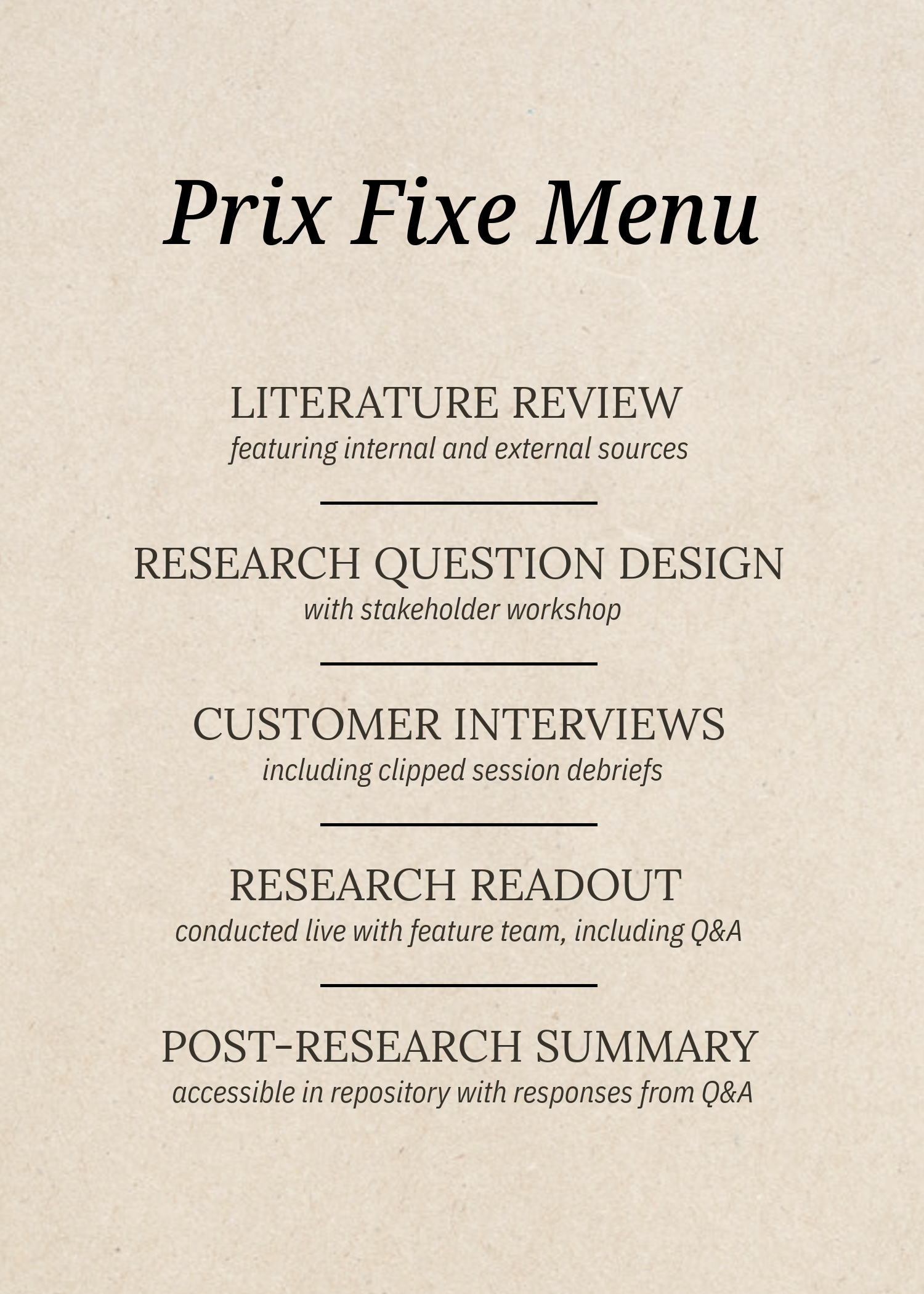
- Literature review (internal and external sources)
- Research question design workshop with stakeholders
- Customer interviews with clipped session debriefs
- Live research readout with the feature team, including Q&A
Benefits: Easy to control for cost and timeline. Highly repeatable. Allows researchers to exercise their expertise in method selection. Typically produces comprehensive insights.
Drawbacks: Not as adaptable to constraints. Requires significant planning and preparation time. May include elements stakeholders don't actually need.
The à la Carte Approach
An à la carte menu lets diners select items individually, creating a customized experience based on specific needs and constraints.
In research terms, this means offering modular elements that stakeholders and researchers can mix and match:
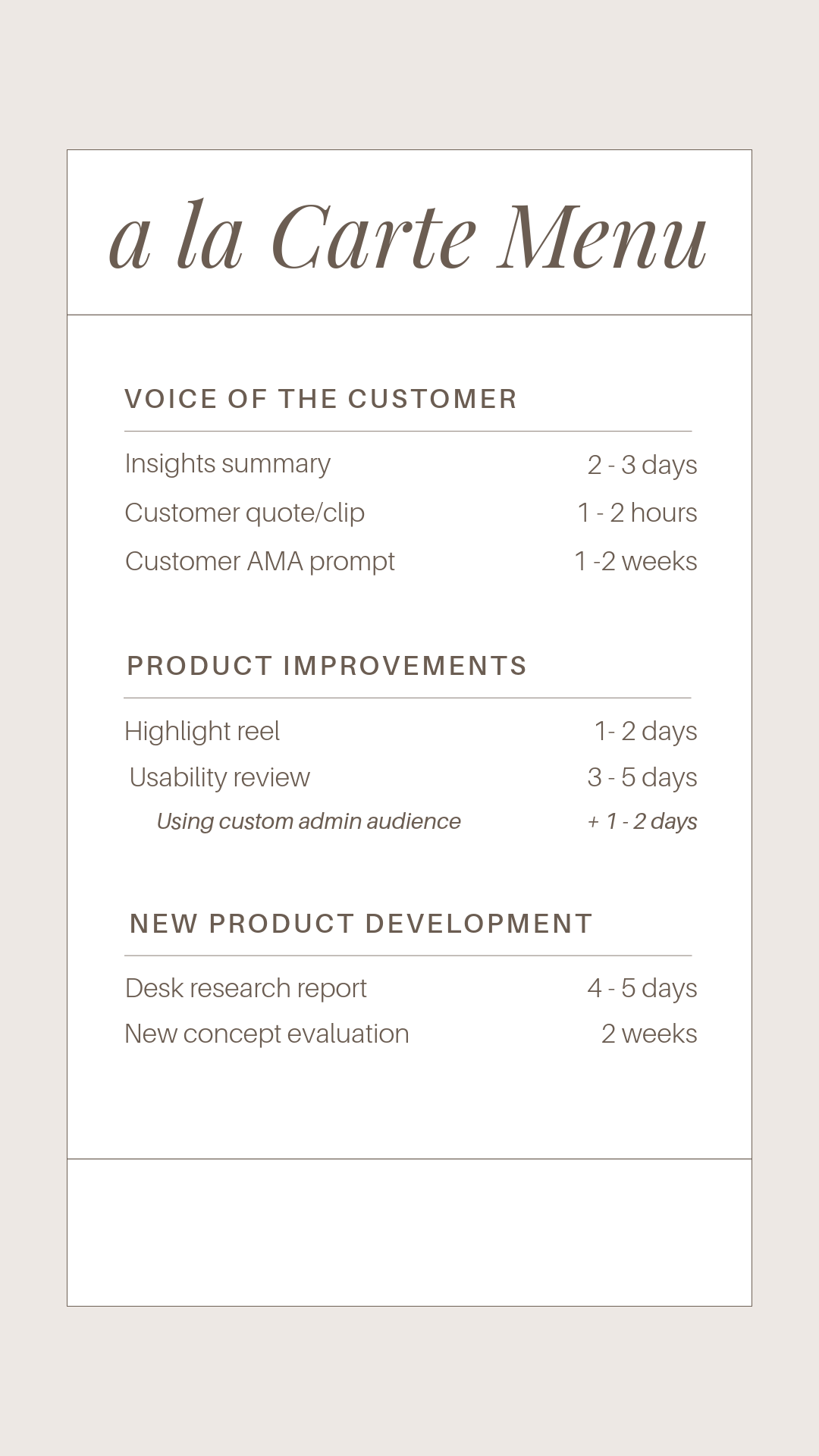
Voice of the Customer options:
- Insights summary (2-3 days)
- Customer quote/clip (1-2 hours)
- Customer AMA prompt (1-2 weeks)
Product Improvements options:
- Highlight reel (1-2 days)
- Usability review (3-5 days)
- Custom admin audience usability review (+1-2 days)
New Product Development options:
- Desk research report (4-5 days)
- New concept evaluation (2 weeks)
Benefits: Flexibility to adapt to constraints. Ability to optimize for specific outcomes. Can serve needs faster when full research studies aren't feasible.
Drawbacks: Not all combinations work well together. Costs can accumulate if too many individual items are combined. Requires more coordination.
Hybrid Models
You're not limited to these two approaches; we can also draw on other dining analogies for additional frameworks:
Omakase ("I leave it up to you"): The chef's expertise guides a semi-structured experience that adapts based on stakeholder needs and available resources. Think collaborative scoping where the researcher recommends the approach but remains flexible.
Set Menu (aka the food truck model): A focused offering of a single, high-quality item delivered efficiently. This might be a recurring insight delivery format—like a monthly competitive analysis or quarterly usability benchmarking—that stakeholders can rely on consistently.
Considerations for Planning Your Menu
As you implement this framework in your own organization, keep three principles in mind:
Consider both needs and capabilities. Don't just think about what your stakeholders want—honestly assess what your team can consistently deliver. An ambitious menu you can't execute will frustrate everyone.
Meet your diners where they are. Different stakeholder groups have different comfort levels with research, different decision-making contexts, and different constraints. Your product managers might thrive with à la carte options, while your executives might prefer curated prix fixe experiences.
Stay flexible. Anticipate that your offerings will change as your stakeholders' needs evolve, your team grows, or your organization shifts priorities. Menus should be living documents, not set-in-stone commitments.
Making It Real
The restaurant metaphor might seem whimsical, but the underlying framework solves real problems:
- For researchers: Clear, repeatable structures reduce the cognitive load of scoping every project from scratch. Standardized insight formats create consistency. Defined offerings help set boundaries and manage expectations.
- For stakeholders: Transparent options make it easier to understand what research can deliver and in what timeframe. Modular choices allow them to get what they need within their constraints.
- For research operations: A menu framework provides structure for intake, scoping, and capacity planning. It creates shared language across the organization. It transforms research from a mysterious black box into an understandable service.
Unlike traditional playbooks that present research as large, single-point strategies, menus are modular and explicitly service-centric—organized around how people want to consume insights, not just how researchers want to produce them.
The Essential Ingredient
Whether you choose prix fixe, à la carte, or a hybrid approach, the essential ingredient is the same: consistency in your core insights. Before you worry about how to serve insights, make sure you've established what makes an insight valuable in your organization.
Then build your menu around the real needs of your stakeholders, the actual capabilities of your team, and the specific context of your organization. There's no one-size-fits-all approach. Different organizations need different menus—and that's exactly the point.
The best restaurants aren't the ones with the most elaborate menus or the fanciest ingredients. They're the ones that consistently deliver exactly what their diners need, when they need it, in a way that keeps them coming back.
What kind of menu does your research organization serve? I'd love to hear about your approach to insight delivery in the comments, or connect with me on LinkedIn to continue the conversation.
Subscribe to my newsletter to get the latest updates and news

Member discussion